






10 AI-Powered Gadgets That Are Actually Useful in 2026
10 Useful AI Gadgets 2026 Buyers Actually Use Past Week One
Every gadget with a chip in it now claims to use AI. Most of them are using “AI” the way 2010 products used “smart” – as a marketing word with no real meaning. The actual useful AI gadgets in 2026 are the ones where the intelligence makes the device measurably better at its job, not the ones where AI got bolted on for the press release.
Here are 10 that earn the label. None of these are about AI being cool. All of them are about AI doing something the previous generation couldnt.
1. Roborock Saros 10R Robot Vacuum
The first robot vacuum where the “AI” is real. The Saros 10R uses a vision system to identify objects (toys, charging cables, dog mess) and avoid them. Previous robot vacuums either failed at this or charged a premium for it. The 10R does it accurately at around $1,200.
It also maps your floor plan, learns furniture placement, and adapts cleaning patterns over time. The previous excuse for buying a Roomba (“its better than nothing”) got replaced by an actual product that does the job well.
2. Audio Pro D-1 AI Powered Bookshelf Speakers
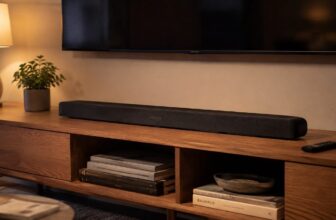
Around $700 for the pair. Built in AI handles room correction (it listens to test tones and adjusts EQ for your specific space), source detection (recognizes voice vs music and processes accordingly), and dynamic compression. The result: a small speaker that sounds dramatically better than its size in any room.
Room correction used to require dedicated DSP and an engineers ear. The D-1 does it in 30 seconds while you sit on the couch.
3. Plaud NotePin AI Wearable Recorder
A small wearable recorder that pins to a shirt, records meetings or thoughts, then transcribes and summarizes with AI. About $169. The breakthrough is the summarization quality – it doesnt just transcribe, it identifies action items and key decisions, which means the recording is actually useful afterward instead of just sitting there.
For people in lots of meetings, this replaces the “I need to take notes but also pay attention” problem.
4. Anker Eufy Edge Security Camera
Around $230. The AI in this camera is local – the chip runs on the device, not in the cloud. It can tell the difference between a person, a vehicle, a pet, and a package. It only sends notifications for things you care about. False positive rate dropped 80 percent compared to cameras that send “motion detected” alerts every time a leaf blows.
Local processing also means no monthly subscription required for the basic features, which is rare in this category.
5. Breville Oracle Touch AI Espresso Machine
Around $2,799. Hear us out on the price. The Oracle Touch reads the puck after each shot and adjusts the next grind, dose and yield to dial in espresso automatically. Pre 2024, that was a manual process that took weeks to master and rebreak with every new bag of beans.
For anyone who actually cares about espresso at home, this is the first machine where the AI shortens the learning curve from “weeks of frustration” to “great shots by day 3.”
6. Bose QuietComfort Ultra Earbuds (2nd Gen)
Around $329. The second generation added “AI Adaptive Audio,” which adjusts ANC and EQ based on environment and what youre listening to. Walking down a busy street, the noise cancellation strengthens. In a quiet room, it dials back. Listening to a podcast, voices get clearer. Listening to music, bass and dynamics open up.
You stop fiddling with settings. The earbuds figure it out.
7. Logitech MX Master 4 Mouse
Around $129. The MX Master 4 added contextual shortcuts that use AI to learn which apps you actually use the side buttons in. In Photoshop, the buttons act differently than in Excel. Over a few weeks the mouse learns your habits without you configuring anything.
The “smart shortcut” feature finally makes the extra buttons useful instead of just there.
8. Ecobee Smart Thermostat Premium (2026 Edition)
Around $250. The 2026 firmware update introduced occupancy prediction that actually works. The thermostat learns your schedule patterns over a few weeks and starts pre-cooling or pre-heating before you arrive home, while running minimal energy when youre out.
Nest tried this for years. Ecobee finally got the algorithm right. Energy bills typically drop 15 to 25 percent after the learning period vs a basic programmable thermostat.
9. Whoop 5.0 Coaching
The Whoop 5.0 strap is recovery hardware, but the AI coaching layer added in 2026 is what makes it actually useful. It analyzes your sleep, training and HRV patterns and gives daily recommendations (“today is a green day, you can train hard” or “your sleep debt is high, recommend zone 2 only”). Around $359 for the device plus $199 to $239/year subscription.
The breakthrough: the coaching is specific, not generic. It tells you what type of workout your body is ready for, not “youre tired today.”
10. Anker SOLIX C800 with AI Power Management
Around $599. The newer SOLIX line uses AI for power management – it learns which appliances you typically run, predicts upcoming usage based on patterns, and balances charging vs reserve to never run out. Sounds like marketing, actually works.
For people who use portable power stations for camping, RV trips, or emergency backup, the predictive management is what separates the SOLIX from the dumb battery boxes for less money.
What Got Cut From This List
We considered and rejected:
- Generic “AI fridges” – the AI doesnt actually do anything useful yet
- AI photo frames – novelty, no real benefit
- AI air purifiers – the sensors arent precise enough for AI to make better decisions than a manual setting
- AI pet feeders – they dont need to be smart to feed a pet on schedule
- AI mirrors – solution looking for a problem
The Pattern
The useful AI gadgets in 2026 share a pattern: the AI does one thing well that the device couldnt do before, and the AI fades into the background. You dont think “the AI is helping me right now.” You just notice the device works better than the previous generation.
The bad AI gadgets do the opposite. The AI is the marketing feature. You have to think about it, configure it, talk to it. Skip those.