We haven’t had these on our counter. This is built from the Amazon listings (prices, ratings and spec claims checked in October 2026), the certifications each listing names, and patterns in owner reviews. Where a claim comes from the maker, we say so, and where a listing didn’t spell something out, the table says “not stated” rather than guessing.
The baseline is the Brita Large 10 Cup at $29.29, rated 4.6 across about 60K ratings. It’s cheap and everywhere, and a lot of people want something with a clearer certification, a longer filter life or a TDS reading. The five below each go a different direction. If you live in a small space, our renter gadgets and dorm room gadgets under $50 lists have more kitchen ideas, and if you’re filling a bottle on the go, there’s the Owala FreeSip review.
1
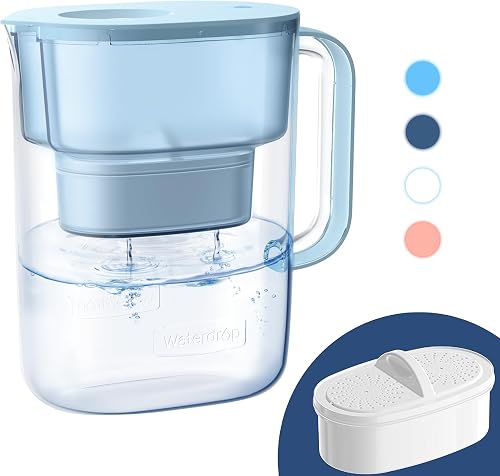
Waterdrop PT-07B
Best cheap swap for a Brita
4.6(16,841 Amazon ratings)
200 gal
Listed filter life
NSF 42 + 372
Listed standards
NSF listedUnder $20
It costs $11 less than the Brita Large and has a higher rating (4.6 from about 16.8K ratings, same as Brita’s). The listing says it passed NSF/ANSI 42 and 372 at a third party lab, reduces PFOA/PFOS, iron, mercury and copper, and lasts up to 200 gallons or 3 months. One line in that listing is worth reading twice: it states plainly that this filter does not lower TDS, and points you to a separate Waterdrop model if that matters to you.
Pros
- Cheapest 10 cup pitcher here
- NSF/ANSI 42 and 372 listed
Cons
- Doesn’t lower TDS, per the listing
- Filter swaps every 3 months at the latest
2
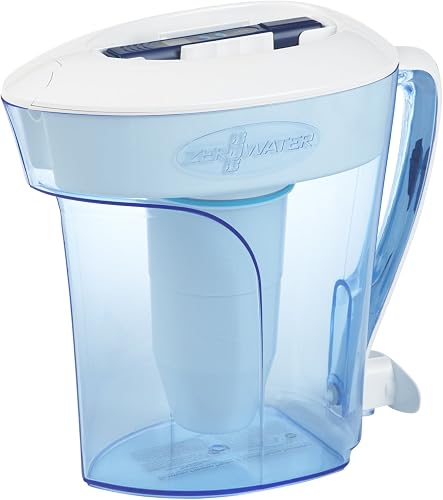
ZeroWater 10-Cup
Best if you want a TDS reading
4.2(49,056 Amazon ratings)
Ion exchangeIAPMO certified
ZeroWater is the odd one out because it uses a 5 stage ion exchange filter that targets dissolved solids, and it ships with a TDS meter so you can check the number yourself. The listing says it’s IAPMO certified to reduce PFOA/PFOS, lead, chromium and mercury. A 4.2 rating on roughly 49K ratings is tied for the second lowest average here, so skim the low star reviews before you buy.
Pros
- Meter in the box, so you see what the filter is doing
- IAPMO certified for lead, PFOA/PFOS, chromium and mercury
Cons
- 4.2 stars across a very large rating count
- The filter life isn’t stated in the listing bullets
3
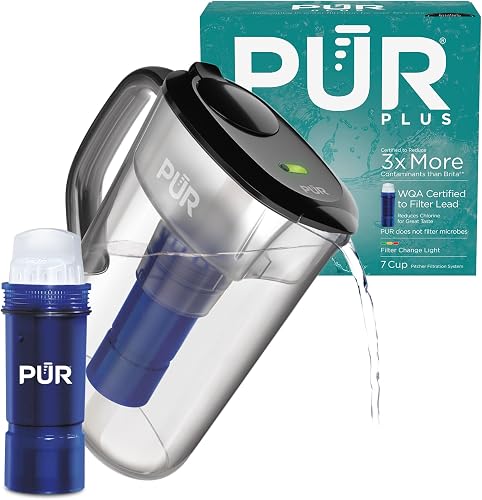
PUR Plus 7-Cup
Best Brita rival with a lead claim
4.2(1,627 Amazon ratings)
Lead reductionCompact
PUR is the brand most people put next to Brita. The listing says its filters are IAPMO certified to reduce lead, and PUR claims they reduce 5X more substances than the leading Brita filter. That’s PUR’s own comparison, so weigh it accordingly. The tradeoff is size: this is the 7 cup version, so it holds three cups less than the Brita Large, and the 4.2 rating comes from a much smaller pool of 1,627 ratings.
Pros
- Lead reduction claim at about $27
- Fits on a fridge shelf more easily than a 10 cup
Cons
- 7 cups, noticeably smaller
- The 5X claim is PUR’s own
4
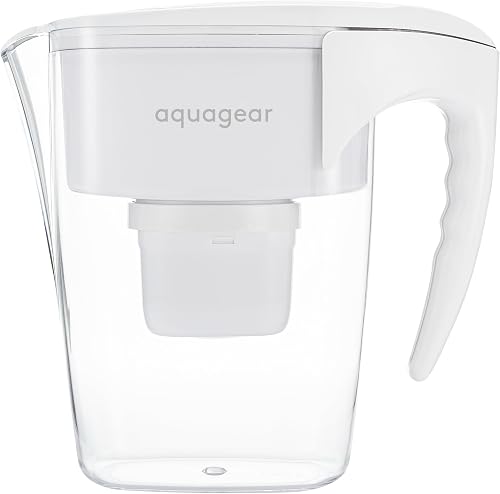
Aquagear 10-Cup
Best for fewer filter changes
4.3(5,595 Amazon ratings)
120 gal
Listed filter life
Lead, PFOA, PFOS
Third party tested
Recyclable filter120 gallons
Aquagear lists a 120 gallon filter life (it calls that three times longer than most standard filters, which is its own comparison) and says the pitcher was third party tested for lead, chlorine, microplastics, PFOA and PFOS. The company also sends a postage paid label so you can return the old filter, which is a nice touch if you hate the trash. At $69.95 you’re paying about 2.4 times what the Brita costs up front.
Pros
- 120 gallon filter life
- Prepaid return label for old filters
Cons
- About 2.4 times the Brita’s price
- Filter life claim comes from the company
5
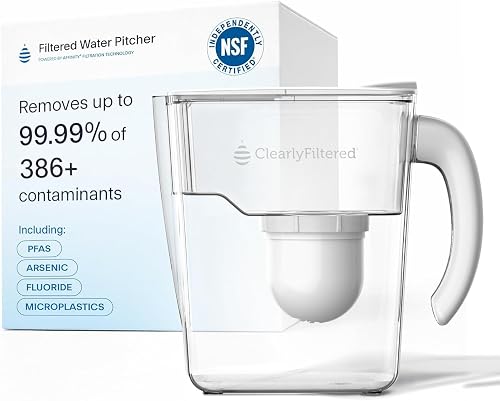
Clearly Filtered 10-Cup
Best for the contaminant list, at a price
4.1(1,092 Amazon ratings)
100 gal
Listed filter life
386+
Contaminants (claimed)
Fluoride claimNSF backed
The listing is the most ambitious of the five. It says the pitcher is backed by NSF certification and targets 386+ contaminants, including fluoride, lead, PFAS/PFOA, arsenic and microplastics, with a 100 gallon filter life. Fluoride is the one that’s rare in pitcher filters, so that’s the draw. It’s also $110, close to four times the Brita Large, and it has the lowest rating of the group at 4.1 from 1,092 ratings.
Pros
- Lists fluoride reduction, which most pitchers don’t
- 80 fl oz capacity
Cons
- Priciest here by a lot
- 4.1 stars is the lowest average of the five
Side by side
| Model | Price | Capacity | Listed filter life | Cert named |
|---|
| Brita Large 10 Cup (baseline) | $29.29 | 10 cups | Not checked | Not checked |
| Waterdrop PT-07B | $17.99 | 10 cups | 200 gal / 3 mo | NSF/ANSI 42, 372 |
| ZeroWater 10-Cup | $37.99 | 10 cups | Not stated | IAPMO |
| PUR Plus 7-Cup | $27.42 | 7 cups | Not stated | IAPMO |
| Aquagear 10-Cup | $69.95 | 10 cups | 120 gal | Third party tested |
| Clearly Filtered 10-Cup | $109.99 | 10 cups | 100 gal | NSF backed |
Which one to pick
For most kitchens the Waterdrop PT-07B is the easy call: it’s cheaper than a Brita and the listing names NSF/ANSI 42 and 372. ZeroWater makes sense if you care about the TDS number. PUR Plus is the one for a lead claim in a smaller pitcher. Aquagear is for people who hate swapping filters, and Clearly Filtered is for people who specifically want a fluoride claim and will pay for it.
One thing that changes the math: filter cost. A pitcher that’s $18 up front can still cost more over a year than a $38 one if you replace the filter every 3 months, so check the replacement filter price on each listing before you commit.
Questions people ask
What does TDS mean on a water filter?
It stands for total dissolved solids, the minerals and salts in your water. The Waterdrop listing says it doesn’t lower TDS, while ZeroWater is built to remove dissolved solids and includes a meter.
Do these pitchers remove fluoride?
Of the five, only the Clearly Filtered listing claims fluoride reduction. The others name lead, PFOA/PFOS and similar contaminants but not fluoride.
Is NSF certification the same as IAPMO?
They’re different testing bodies that certify against standards. What matters is which specific contaminants and standards the listing names, so look for the standard number (like NSF/ANSI 42 or 372) instead of a general “certified” badge.
How often do I need to change the filter?
Waterdrop lists up to 200 gallons or 3 months, Aquagear lists 120 gallons and Clearly Filtered lists 100 gallons. Your tap water and how much you filter decide the real number.